

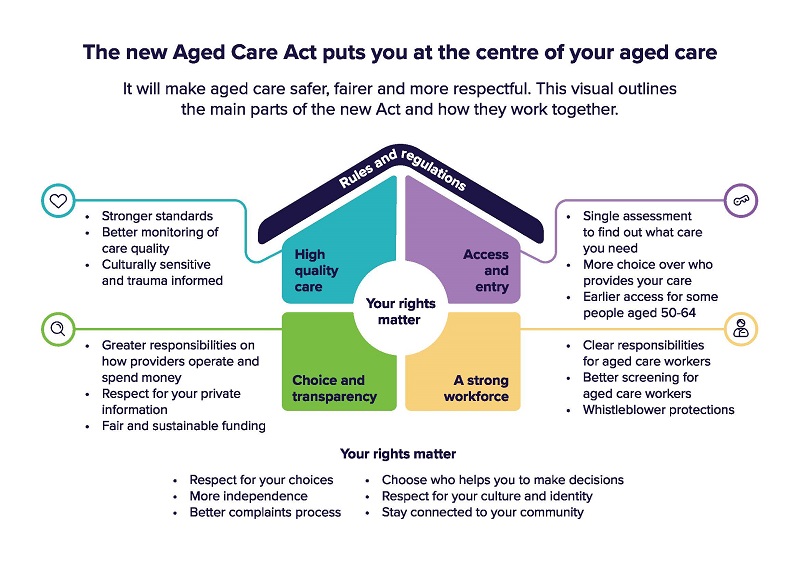
Currently, aged care is governed under many laws. The recent Royal Commission into Aged Care Quality and Safety found that the current Aged Care Act and its related legislation was no longer fit for purpose as it was primarily focused on providers and how to fund them instead of the people accessing aged care services and what they need.
The new Act replaces the Aged Care Act 1997, Aged Care (Transitional Provisions) Act 1997 and Aged
Care Quality and Safety Commission Act 2018. It will be the main law that sets out how the aged care
system operates, aiming to make it stronger and coordinate everyone who is connected to it.
The new Act responds to recommendations from the Royal Commission and encompasses a Statement of Rights for older people. Once it comes into effect on 1 November (delayed from 1 July), it will strengthen Aged Care Quality Standards and broaden powers for the Aged Care Quality and Safety Commission.
The new Act also aligns with the launch of Support at Home program, designed to help older Australians live independently at home for as long as possible. It was created in response to recommendations from the Royal Commission and focuses on providing timely, equitable, and higher-quality care for older Australians who need it.
It will replace the current Home Care Packages and Short-Term Restorative Care programs, with further changes to follow in later stages. It includes better access and funding, upfront preventative support, improved restorative care and end-of-life pathway.
In the past 10 years, the number of Australians in home care has increased fourfold. By 2035, Support
at Home will help around 1.4 million people stay in their homes as they age. In the next 40 years, the
number of Australians aged over 65 is expected to more than double, with those aged over 85 to more than triple.

This article was published in the
June 2025 edition of Golden Years.